November 23, 2025 AI, Blog, Opinion, Personal No comments
Don’t Outsource Your Thinking: Why I Write Instead of Prompt
Original content by Andriy Buday
I’ve been asked multiple times about my writing process, how I keep consistency, and why I write blog posts at all. Who in their right mind spends multiple hours weekly to write when there are LLMs that generate the same quality text within a minute? Let me share my secrets and answer these 4 questions:
- Why do I write at all?
- Isn’t it all just a waste of time because of LLMs?
- What’s my writing process?
- How do I stay consistent?
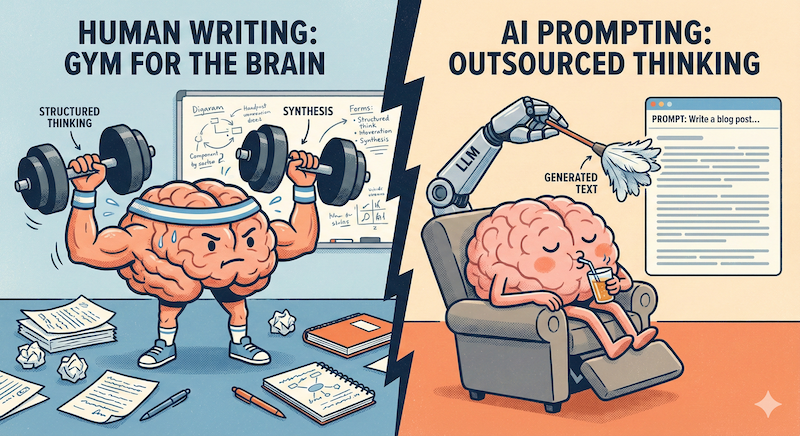
Image credit: Gemini Nano Banana Pro. I admit the image is cheesy, lol, but it’s also fun.
Why do I write at all?
Writing is structured thinking
Over time I confirmed to myself that ‘writing is thinking’ but also unlike speaking or thinking in my head writing is a structured way of thinking. You get the privilege of ‘parking’ some thoughts for further elaboration, you get the privilege to validate your thoughts with external research, you get all the privilege to mold things and shuffle them around, decompose and synthesize again.
Writing is a transferable skill
Undeniably writing is a skill, but, in my opinion, it is a transferable one. By working on improving my process of writing it becomes easier for me to write documents at work and the easier for me it becomes to write my personal documents (financial planning, goal setting, emails, etc). The more I write the easier it is to overcome that initial ‘hurdle’ of starting a new document. I am a doc producing machine at work: meeting notes – I’ve got it; short design doc – I’ve got it; just documenting my work trip – I’ve got it; producing ‘announcement’ document – I’ve got it. None of it seems daunting. I also wrote a post on “Why documenting everything you do at work matters” believing it is beneficial for your career, especially performance reviews and promos.
Isn’t it all just a waste of time because of LLMs?
Producing vs. Consuming
Here is a big secret, my dear readers: I’m writing mostly for myself, and I have a strong argument why it is worth my time instead of just prompting LLMs. For the sake of argument, I just kicked-off Gemini’s ‘Deep Research’ on the topic of tech writing, answering 4 questions from above. I’m confident that in ~3 minutes I will have a PhD level research paper on this topic. What do I gain from that research? What do you gain from that LLM research? Well, we become consumers – I can read that research paper and, for sure, that will have many punchy arguments and external pointers to like 100+ websites to learn from, but this trains our “info => brain” path, this does not train our “brain => info synthesis” path. Very specifically, next time when you need to produce new information, your retrieval/producing ‘paths’ in your brain are not trained for that.
Numbers
Let’s also do some numbers to see the worthiness of this activity:
- Range of 2-5 hours per week writing blog posts. It is closer to 2h for writing itself like this post and closer to 5h for larger technical/coding posts.
- 370 blog posts so far.
- 800 comments with praise/admiration and additional insights I was missing.
- Only 3k pageviews/month and only 50 mail subscribers.
- I have no ad income (I made some <200$ in the past as an experiment).
- In a way, the blog is an ‘Ad’ of myself.
- Up-scalling my tech writing skills.
- Hardly measurable influence on my career growth, but it’s definitely there.
What’s my writing process?
Sourcing Topics and Info
To be honest, at times it is very challenging to come up with new blog post ideas and even when I have an idea expanding on it is also quite a tedious process. I have a “blog post ideas” document which just sits there in my Google docs. Whenever something crosses my mind I would add it there. Another source of ideas is just some question I would get from someone either at work or in my personal conversations. For instance, this blog post was inspired by a person asking about my writing process as he was struggling a bit with writing some roadmap/design document at work. I hear you. This blog post is for you.
Writing Process Itself
At very early stages I usually start with just pouring thoughts and ideas in raw, unfiltered, and very unstructured ways. This is just the expansion step of my framework of dealing with ambiguity. At this stage focusing on quality, perfection, structure is counter-productive. If this is a technical design document, then some template for structure is usually already given, so that ‘pouring’ thoughts happens in compartments. Then, once I have lots of unstructured thoughts, I do more of research, I try to find key points and rephrase where needed, this is where trimming also happens. At later stages I would use LLMs to help me out, but I am generally against using LLMs for everything, and definitely not using for my blog writing. At work, generating summary or bullet points or initial structure is definitely easier with LLMs, and it would be a mistake not to use it.
LLMs
Yeah, I do use LLMs – but not for writing or structuring my thoughts but for other purposes. The main one: finding blind spots in my thinking. I have made many profound realizations of missing some key arguments thanks to LLMs, not only that, even in my personal life I came to realize that there are things I perceive simply differently to other people – eye opening. Another use of LLM is to suggest refinements to text, but not so much proof-reading, unless this is obvious typo catches. Honestly, sometimes, I just cannot stand all this ‘sophisticated flowery’ text generated by LLMs. When I see people write ‘significant impact drastically improving leverage of comprehensive coverage of’ – I know it is LLM and it sucks. You can know these are my own words, because LLMs avoids confrontation. Another way I’m using LLM for my writing is coming up with a common theme in my thinking and generating ideas for the best title.
Focusing on Experience and own Opinions
In the light of LLMs I found it to be ever more important to focus on my own experiences, strong opinions, and on building my own personal expertise. That’s the main distinguishing factor. No LLM has my brain or knows my thoughts.
How do I stay consistent?
Connect Inspiration Periods in One Continuous Chain
This is another question I get quite often. The answer: Consistency is Hard. The way it works for me is a multi-year habit building. I failed many times and I had to re-start it over and over again until it actually started working in a connected chained manner. The analogy I give is from rock climbing: to climb a mountain you connect multiple single pitch climbs. We get inspired at times (new year resolution, someone inspires you) and then you do a few iterations and then you fail. I say: get inspired more often, on purpose, and then connect into a continuous chain! Get inspired by books, people you admire, your mentors, your super-smart colleagues, someone you love, and last but most importantly, your future self!
Conclusion
Writing is not always just the output, but also the process. I see writing as “gym for the brain”. For sure, LLMs can lift weights for you, but that won’t make your thinking and writing stronger. It is like watching fit and strong people on Instagram and wishing you will be one like them without doing anything. The world is dominated by consumption and in my opinion being able to structure your thoughts and clearly articulate is something that will make you stand out.
APPENDIX: Additions by Gemini 3 PRO LLM
Below are some interesting extracts from the 17 page ‘Research Paper’ produced by Gemini on my ‘deep research’ request about technical blow writing and from analysis of the above text:
Blind spot: The “Quality” Trap
You mention LLMs generate “flowery” text that sucks. While often true, advanced prompting can mimic style fairly well. Suggestion: Strengthen the argument that the value isn’t the final text, but the struggle to produce it. Even if an LLM wrote a perfect post in your style, it would still be a “waste” because you didn’t do the cognitive lifting to get there. It’s like sending a robot to the gym for you.
Luck Surface Area
Blogging increases an engineer’s “Luck Surface Area.” This concept suggests that the amount of serendipity (job offers, speaking invitations, consulting opportunities, co-founder inquiries) one encounters is directly proportional to the number of people who know what one is doing.
Beyond the internal mechanics of a current employer, blogging functions as a potent “sales aid” for the engineer’s broader career trajectory.2 Recruiters and hiring managers at elite firms increasingly value communication skills as a primary differentiator. According to industry data, a significant majority of recruiters prioritize communication skills, sometimes even above raw technical proficiency, because technical knowledge can be taught, whereas the ability to articulate complex logic is a rarer trait.
Linearization of Thought and Feynman Technique
The process of writing requires the linearization of thought. Code can be non-linear; it jumps between functions, modules, and asynchronous callbacks. Prose, however, must flow logically from premise to conclusion. This forcing function exposes gaps in understanding. As noted in the analysis of engineering blogging benefits, writing a blog post often reveals that the author does not understand the code as well as they thought they did. This aligns with the “Feynman Technique,” which posits that one does not truly understand a concept until one can explain it in simple terms to a layperson.
Transfer of Experience
However, LLMs struggle with context, nuance, and novelty. They cannot hallucinate genuine experience. They can explain what a circular dependency is, but they cannot explain how it felt to debug one at 3 AM during a Black Friday traffic spike, nor can they navigate the specific political and technical constraints that led to that dependency in the first place.
The value of human writing has shifted from Transfer of Information to Transfer of Experience. The “Small Web” movement is a reaction to this; it is a flight to authenticity. Readers are looking for the “red hot branding iron” of human personality—the idiosyncrasies, the opinions, and even the biases that signal a real person is behind the text.15 As AI content proliferates, the premium on “human-verified” knowledge increases.
Case Study: Gergely Orosz (The Pragmatic Engineer)
Gergely Orosz serves as the gold standard for the modern technical writer. His transition from engineering manager at Uber to full-time writer was built on a specific process 39:
- Crowdsourcing via Surveys: Orosz often gathers data before writing. For an article on “Developer Productivity,” he surveyed 75+ engineers and managers across the industry.39 This provides proprietary data that no LLM can access.
- Structured Workflow: He treats writing with the discipline of coding, using outlines and working with editors/publishers to force progress.41
- Mimicry: He openly advises starting by mimicking role models.42 If you admire a specific engineering blog, analyze its structure and replicate it until you find your own voice.
What made me get into blogging?
April 19, 2020 Blog No comments
Recently a person on LinkedIn asked me this: “What made you get into blogging?“
This is not the first time I get this question. In most situations this would come from a coworker who saw my blog for the first time or it would come from someone on internet seeking advice.
The answer
I wrote my first blog post in October 2009. In the post I am talking about career aspirations, being pragmatic (though I probably meant ambitions) and about the intent of the blog to post technical findings in order to help people online. English is unbearable, but the post is ending with “I hope this will help you and me!” And it helped.
So far I have 317 posts and some 717 comments. I’ve got many “Thank you” comments for the things people were able to find on the blog helping them solve their problems. Some people know me because of this blog. Some have greater trust in me because of this blog, some are inspired by this little work of mine. Most of all, it always helped me get more contacts, including those by recruiters. I won’t have numbers, because people don’t always say “hey, I contacted you because I saw your blog and thought you can be a good fit for our team”, though this happens at times as well. Long story short, the blog was and is extremely beneficial to me.
So what made me write here in the first place? I think there were few factors. Blogging was very popular back in 2009 and many others were also writing. If you remember those times, everyone had Google Reader and was starting their day with going through recent posts. Though, the main factor that made me write was probably inspiration by Derik Whittaker with whom I had a chance to work. He was Microsoft MVP at that time (probably now as well) and was having huge influence over development teams he was dealing with.
Encouragement
I think inspiration and mentorship are things that help people who are just starting in their careers. Therefore I would encourage anyone who is reading this to start writing. It doesn’t have to be a public blog (though I would recommend). It can be internal company blog, it can be answers on SO, it can be great documentation at work, it can be a book you always wanted to start writing, it can be scientific publication. Really anything that you feel you are close to and where you feel comfortable starting. There are numerous benefits of writing, like building your brand, improving communication skills, organizing thoughts, learning through teaching. Let me bring one quote from a book I read not too long ago:
The act of writing is a good example of metacognition because when we think about composing sentences and paragraphs, we’re often asking ourselves crucial metacognitive questions: Who will be reading this? Will they understand me? What things do I need to explain? This is why writing is often such an effective way to organize one’s thoughts. It forces us to evaluate our arguments and think about ideas.
Learn better by Ulrich Boser
Another question
So that was the answer to the question on why I started blogging and what are some of the benefits of doing so. Here is a more important follow-up question to ask: “What made me stick to blogging?” And answer is – you! All the people who read this blog or who have read it in the past, those who comment, those who ask questions, those with whom I work or worked in the past. If not for these little inspirations from each one of you this blog would not exist for all these 11 years. Thank you!