October 5, 2025 Opinion, RandomThoughts No comments
Finding Your Voice at Work
“If you stay silent as a mouse you will just stay where you are.“

This was the advice I got from a team lead at my first job, right after I’d rushed through the office to complain about a broken system that endangered a delivery to our client the next week. He praised me and didn’t want to shut me down, even if I might have overdone it. For many of us, finding that voice is the hardest part. We hold back our ideas, questions, and concerns for a number of reasons. Let’s break down the four most common ones:
- We assume that something is obvious.
- We assume that others know better.
- Deference to authority.
- Physiological: not feeling safe, fear of judgement.
Stating the Obvious
One of the biggest mistakes we make is assuming that others have the same knowledge or perspective as we do. What seems obvious to you is often the result of your unique experiences, learning, and context. But others may not have the same background.
One of my university professors used to say there are only three types of proof: by contradiction, by reasoning, and obvious. I struggled with the 3rd one because when something is somehow “obvious”, it wasn’t that obvious to me at all.
Quickly re-stating that “obvious” part often removes the ambiguity from the discussion and sets the common baseline. Without being aligned on the same baseline the entire conversation doesn’t make sense, that’s why it is super-important to simply re-state the “obvious” and explicitly list what the assumptions are.
Sometimes I notice how very senior leaders would ask very basic questions about something only to witness that not everybody in the room was on the same page about this basic truth.
Sharing the “obvious” has very little drawback. While there may be a small cost, say a bit more document space or an extra minute in a meeting, that cost is a cheap insurance policy against catastrophic misalignment. A little information overhead is always better than massive miscommunication.
Others know Better
It is oftentimes true that others know better (to state the obvious). But this shouldn’t be a blocker, rather it should be an incentive! If you speak up and you’re wrong, you become the main beneficiary: you get corrected and learn a critical piece of information. If you’re silent, you leave the meeting still misinformed. If a question is forming in your mind, it’s highly likely that several other people in the room are thinking the exact same thing but are too afraid to ask. By asking, you don’t expose your ignorance; you serve the collective need for clarity.
Deference to Authority
Sometimes it’s not fear or lack of clarity, but simple deference to authority. When senior leaders are present, people instinctively stay quiet, assuming their ideas matter less or that others will take the lead. This one is tricky as it also includes some cultural aspects of how you were raised and also cultural aspects of your company.
More often than not, however, leaders actually want more people to speak. They value a challenging question or divergent perspective far more than a room full of nodding heads. In fact, leaders sometimes speak first precisely to kick-start the conversation, and they often intentionally hold back because they don’t want their presence to silence the room. In fact, sometimes leaders don’t speak at all precisely because they want to ensure others feel there is room to contribute. Silence out of deference is perceived as alignment, which can lead to misguided decisions. Don’t assume your idea matters less. Assume your perspective is a critical puzzle piece the decision-maker needs.
Physiological Safety
This one is a tough one because it’s rooted in our fundamental human desire for psychological safety. This is a need that is not always easy to satisfy in high-pressure environments, such as the big tech corporate world.
Google has done this famous study “Project Aristotle” which concluded that psychological safety was the number one predictor of a team’s effectiveness, more so than the individual skills, intelligence, or seniority of the team members. The “how” a team worked together was more important than the “who.” Safety there means that team members are confident that no one will embarrass or punish them for admitting a mistake, asking a question, or offering a new idea.
Being comfortable taking “interpersonal risks,” such as challenging the status quo, offering divergent ideas, or asking for help is a lot more beneficial than taking another risk of closing in and solving the problem on your own.
Conclusion
The path from “mouse” to “wolf” isn’t about aggression or volume. It’s about recognizing that your unique perspective is a crucial piece of the collective intelligence. Your job isn’t to be an expert on everything, but to ensure that the room has all the information it needs: whether that’s stating the obvious, asking the ‘dumb’ question, or challenging the senior leader. So:
Ask the ‘n00b’ question. Challenge the status quo. State the obvious. Share your ideas. You lose virtually nothing, but the collective clarity and your growth is a big win. Speak up!
Is AI Redefining Software Craftsmanship?
August 2, 2025 AI, RandomThoughts No comments

Let’s debate over the question: Is AI redefining what software craftsmanship is?
To answer this question we must first define and expand on what software craftsmanship is.
Software Craftsmanship (SC) can be defined as a mindset and approach to creating software that puts emphasis on quality, elegance, adherence to best practices, and continuous skill development.
Many ideas behind SC are shaped by books, like “Clean Code”, “The Pragmatic Programmer”, “Code Complete” and more. I’ve personally read these books in the past and have considered myself to be sort of a Software Craftsman, mainly because of taking pride in producing high quality code.
Let’s explore the “Yes” argument with an example. In my 2012 blog post “100% code coverage – real and good!” I argued that striving for absolute test coverage is not only realistic but professionally responsible saying it pays off in the long run. Recently, I worked on logic that needed new unit tests. AI generated over 100 tests for me, covering all the edge cases. It saved me tons of hours of work. I now treat these tests as a black-box safety harness. If I change the logic and introduce a bug, I expect one of them to fail. If I need to refactor heavily or modify API signatures, I simply ask AI to regenerate the tests. I no longer care if helper methods in the tests are extracted or follow perfect conventions because that’s now a solved problem. So, yes, AI is redefining what a software craftsman does.
Let’s explore the “No” argument. A colleague of mine, gave this example: in the privacy space, AI can generate some “good” code, but it might not go as far as to care about whether using a raw pointer in C++ code is higher risk because of the privacy context, and if you are not a SC you would simply not pay attention to that part and let it slip, similarly how I would not care about that extracted method in unit tests. So the argument goes, that AI cannot truly produce SC’s level of quality. Playing a bit of devil’s advocate, I think, AI will actually get good at caring about raw pointers, extracted methods, and other things like that. Perhaps we’re not replacing craftsmanship but rather we’re just shifting it to a higher level of abstraction.
To finish off, there was a time when people wrote in absolute binary (01110110) using absolute machine addresses and many programmers of that time resisted using symbolic approaches (like FORTRAN). The adoption by professionals was slow, because, hey, that’s “not true programming”. To replace another popular statement:
Software craftsmen won’t be replaced by AI, but those who use AI will replace those who don’t.
P.S. The idea for this post originated from a random conversation over dinner with a random co-worker I’ve never met before.
Using Back-of-the-Envelope Math to Pressure-Test Ideas
July 27, 2025 RandomThoughts No comments
This post is a bit of an experimental thought exercise, but I hope you will find it interesting. You might have run into the term “back-of-the-envelope calculations” in the context of system design at work, quickly checking if an idea makes sense, you might have heard about this term as ‘back of a napkin’. In this post I would like to explore a few applications of using this. Let’s look at some made-up examples, starting with a broken tool and ending with a mathematical formula for success.
Case 1: Broken Tool
Problem: Let’s say some kind of a validation tool at your big enterprise company is running into timeouts. Annoying, but after retry it goes away, so engineers don’t report the annoyance that much. You’ve had enough of it and complained to the owners by creating some bug reports but there is no traction whatsoever. Things continue like that for a while.
Solution: Spend just mere 10-20 min to do back-of-the-envelope calculation to estimate the implication of this. No need for precise data – just something that makes sense to get the point across. E.g. this tool slows down X engineers on daily basis and they spend Yh of time waiting for the job to complete, then assume some reasonable coefficient k (0<k<1) of waiting async time to sync time and you get something of E = (k*Y*X) of ENG time per day. k, Y, X could come from data if you have it right away, or reasonable assumptions (org size, anecdotal data). If E number is 8h then the cost of things continuing is one engineer full time. Probably this is worth fixing and gives you a good argument for quickly justifying ROI.
Case 2: Validating compatibility of statements
Let’s look at a more complicated and borrowed example from the book “The Art of Doing Science and Engineering” (great read, btw). There are two statements in the book and the author validates their compatibility, based on the premise that amount of knowledge is somewhat proportional (k) to number of scientists:
- Statement 1: knowledge doubles every 17 years;
- Statement 2: 90% of the scientists who ever lived are now alive.
Now, the author starts with the formulas: 


But hold on! By now this all might sound very convincing, but the above seemed to make sense in the post-WWII world, but current data no longer strongly supports the two statements, UNESCO suggests 8.8M researchers in 2018, but the projections are pointing to plateauing of this because most of the growth in 00’ and 10’ was coming from China’s growth, which no longer continues at that rate and at the same time EU, US has already reached plateauing (other findings on this). Also the original doubling of the knowledge statement is questionable. Potentially doubling of information is still happening fairly frequently if we consider material that is being generated by AI.
My mini-conclusion for this example is that you can arrive at reasonable confirmation if what someone is saying makes sense generally, but it may not hold true for a long period of time.
Case 3: System Design
Let’s say you are sketching an idea for your startup for which latency of processing data is critical, without going into too many details you can get a sense of how much time it takes to process your data at different stages and whether your solution is worth exploring further or not or if you need to find a different solution.
Some typical numbers:
- Transatlantic network roundtrip: ~80–120 milliseconds
- Reading 1MB from network (LAN): ~0.5–3 milliseconds
- Reading 1MB from disk:
- HDD: ~5–15 milliseconds
- NVMe SSD: ~0.1–1 milliseconds
- Reading 1MB from memory (DRAM): ~150–300 microseconds
- Processor thread synchronization (mutex): ~20–300 nanoseconds
- L1 cache access: ~0.5 nanoseconds
Case 4: Formula for success
Switching gears. Let me run a silly thought experiment: you want to model what it takes to succeed as a mathematical formula. Maybe, you want to increase chances of your kids succeeding and being happy. You can come up with some parameters of what you believe have influence on success and then think about possible relationships between them that would determine success at time t based on past success at time t’:
- B(t0): Birth conditions (location, socioeconomic status at birth).
- E(t′): Quality and quantity of education at age t′, where t′<t.
- R(t′): Availability and utilization of resources (money, time, social capital) at age t′.
- H(t′): Individual’s health (physical & mental) at age t′.
- N(t′): Personal and professional social network strength at age t′,
- D(t′): Individual’s level of determination and perseverance at age t′.
- L(t′): Luck or random positive/negative events at age t′.
Then, you might arrive at a generalized mathematical formula for success at age t:

where:
- α,β,γ,δ,ϵ,ζ,η are weighting factors, representing the relative impact of each component (these could be determined empirically or statistically).
is a discounting or decay function indicating that recent events often influence current success more than distant past events (λ is a decay parameter).
You might conclude that an individual’s level of determination has the greatest impact, and decide to focus on developing that trait in your children.
Conclusion
You don’t always need precise data to move forward even for something that may seem overly complex and even abstract. Quick estimates let you sanity-check assumptions, challenge vague claims, pressure-check ideas, and decide if something is even worth exploring. Quick estimates help you move fast and avoid getting lost in BS and even rough mathematical formulas might help you structure your thinking about complex matters before you dive all the way into it. Anyway, just some random thoughts from my side — curious what you think.
What I don’t like about meetings
October 19, 2024 Opinion, RandomThoughts No comments
I estimate I’ve been to 10k (*) meetings in my career (holy smokes) and I’ve never written a blog post on meetings, so here it is. There are tons of recommendations online on effective meetings, things like having an agenda and setting goals for the meeting, inviting only necessary attendees, etc. In this post I would like to highlight just a few things that I think I might be doing differently and I will bring them in light of what I don’t like about the meetings :)
“What are we discussing?”
Let’s start with this: I really don’t like when people call for a meeting and don’t provide even a line of context or agenda. First of all this doesn’t give me or others means to properly prepare for the meeting. Effectively by not providing context or agenda the organizer is robbing themselves of a chance that some attendees will have more to contribute to the meeting. Additionally there is a good chance the meeting will be hijacked. In my view not having an agenda shows a grain of disrespect because the organizer demonstrates that this isn’t something important to them either.
- DO: Always, always add a bit of description to the meeting invitations you send. At a minimum say that the agenda is coming if you need more time to prepare but have to book time. But most of the time target creating meeting notes documents and adding context, agenda and any relevant info to the doc.
“So what was the decision?”
Another thing I don’t like about meetings is when there is not a single output artifact. After such a meeting, I’m asking myself “What was I doing here?” Lately I started solving this problem by just starting to take notes in meetings independently of my role in the meeting. If no one is presenting their screen I will just silently start sharing mine with notes being taken. I’ve been thanked on multiple occasions for notes that appeared out of nowhere. I’ve also been complimented for keeping the best track record of 1:1 or other discussions where I play a more active role.
- DO: Always play a role in the meetings you are attending. If noone is taking notes, take them yourself, if no one prepared an agenda/context but you have context – just create that doc. Maybe request the organizer to add the notes. Just 5 min of your time could make the meeting go in the direction you want it to go. Yeap, this is because by sharing the screen and people reading the context and agenda you put they are likely to follow some of that even if they are 2-3 levels above you (you can influence without authority in such a “weird” way). For big townhall kind of meetings, always attempt to prepare one question, this will keep you engaged in the meeting, otherwise just don’t join.
“That could have been an email!”
Oh, I also don’t like long or “that could have been an email” meetings. You know, those where all the useful information has been shared and discussed in the first 5-10 minutes and then people just chat about related topics and say they need time to think about it and respond, meaning that if it was an email the course of action would have been the same.
- DO: Well if something can be shared/asked via email just do it. But if you have to have a meeting schedule just enough time for what has to be discussed. You will be pressured to arrive at a conclusion within time you have and if you really need more time just schedule a follow-up. I found that 30 minute meetings are almost always enough.
“I want out of here.”
Oh, how about the “fill the void” where you feel like there is pressure to say something? In these kinds of meetings those who like to speak a lot take pleasure in just speaking and speaking and those who don’t like speaking secretly cannot wait for the meeting to be over.
- DO: If you are leading the meeting, encourage people to speak so long as new ideas are flowing and value is being added. The moment things become repetitive, same people talk non-stop, or there is disengagement, consider concluding the meeting, no shame in that. If anything people will thank you.
Conclusion
Unquestionably we need to meet at work. The purpose of meetings is to add value, help arrive at decisions and drive progress. The things that frustrate me the most, like a lack of agenda, no clear outcomes, and unnecessarily long discussions, are often avoidable with just a bit of effort and intentionality. By always preparing an agenda, ensuring there are actionable takeaways, and taking control when needed (even as a participant), you can influence the flow and value of a meeting.
(*) 16 years x 52 weeks x [5(early career) – 20(later career)] meetings/week = [4k – 16k]
My Home Office Setup
October 18, 2020 Opinion, Personal, RandomThoughts 11 comments
First things first, this is not a “how-to” post explaining you the “one right way” of setting up your home office. I am a Software Engineer (you are likely to be one as well) and like yours, my home office setup is probably somewhere in between coding on sofa and science-fiction command center. In this post I’m just sharing what I’ve done to improve my home office situation and what I’m thinking might be worth to improve it even further. I will be glad to hear any feedback or advice you might have on this.
Location
Reducing noises, keeping kids from fighting for your immediate and undivided attention, avoiding kitchen temptations, dog barking or whatever else is applicable to you, might be one of the most important factors for your home office, yet it might be the one you have the least control of. I do not pretend to have a batcave for work from home either. In fact, I started working on sofa when COVID first hit in March and then quickly realized this wasn’t a good idea. Step by step I improved my WFH situation and currently have something reminiscent of an office. I’m renting a relatively large apartment, though it obviously wasn’t designed with a workspace in mind, so I’m using a bedroom. Yeah, a bedroom! I have rearranged the furniture in a way logically separating the room into office and non-office halves. In this post, I am going to show pictures of my office half. (Not too eager to post photos of my bed, especially when it is not made up :)).
Desk and equipment arrangement
I’m in favor of simplicity and minimalism when it comes to my desk. Even when I was going to the office I would usually keep it empty from anything non-essential. So here is my arrangement:
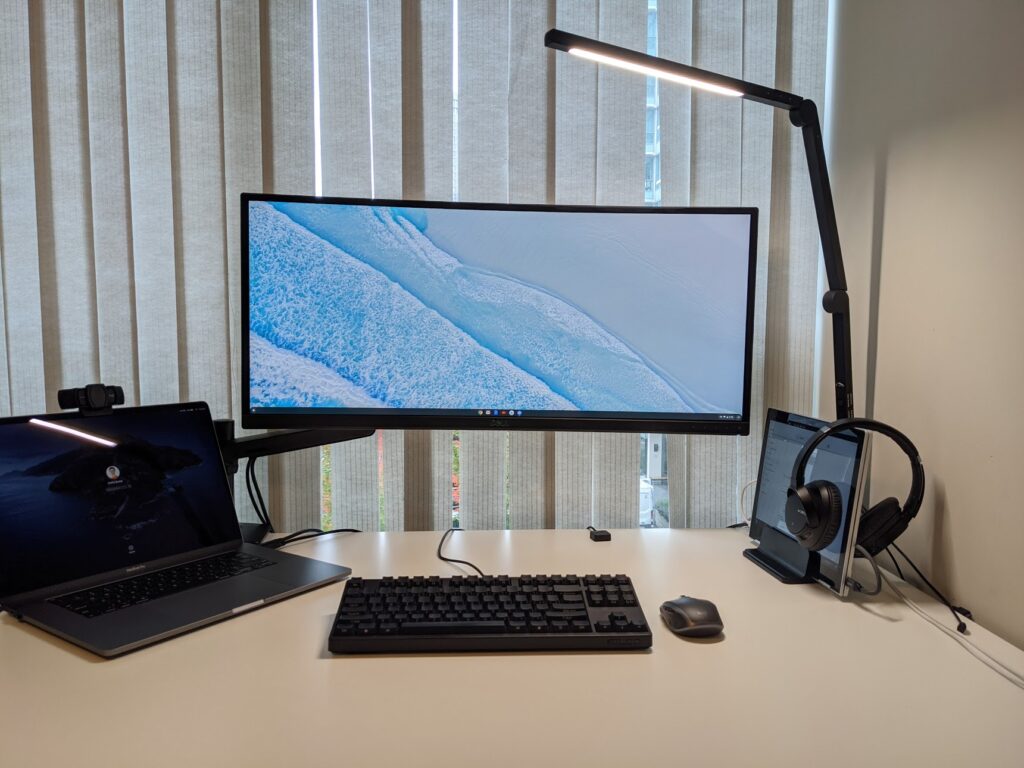
On the left you see my work laptop with two cables. First cable goes to a docking station serving as a power source and connecting the laptop to 300 Mbps internet (seems to be enough ¯\_(ツ)_/¯) as well as to external camera which you can see on the top of the laptop (I will touch on this again later on). Docking station has enough ports to add more peripherals. Second cable connects my work laptop to KVM. If you see, there is a small button in front of the keyboard – that’s KVM switch allowing me to share 34″ monitor and keyboard between laptops on the left and right. Laptop on the right is my personal laptop. I intentionally don’t login with my personal account on my work laptop for multiple reasons (will touch on this later as well). There is also a desk lamp and desk power source located in the right corner mostly for charging devices (2 USB-C, mini-USB, Garmin). I might keep few different sets of headphones on the desk, but usually prefer to keep them in the back of my “office”.
List of Equipment and details
Except of work laptop and few small things, all equipment is something I bought with my own money before I knew my new employer is so generous to give 1000$ to its employees to improve WFH situation [public info]. Below is the list of the equipment I’m using with links to Amazon for reference only – those are not referral links (I’m not trying to make money on your clicks, and this post is not written for that purpose).
Monitor: Dell UltraSharp U3415W 34-Inch Curved LED-Lit Monitor (Older Model) It is a nice wide curved 34″ monitor I can easily use as if I had two with tools like Spectacle on mac or built-in shortcuts on chomebook. The only regret I have is I should have probably went for newer version with more aggressive curve and USB-C support.
Monitor Stand: AmazonBasics Premium Single Monitor Stand This allows me to bring the monitor forward/backward, up/down or change the angle. This is so much better than having monitor placed stationary. It also allows to free up some space on the desk.
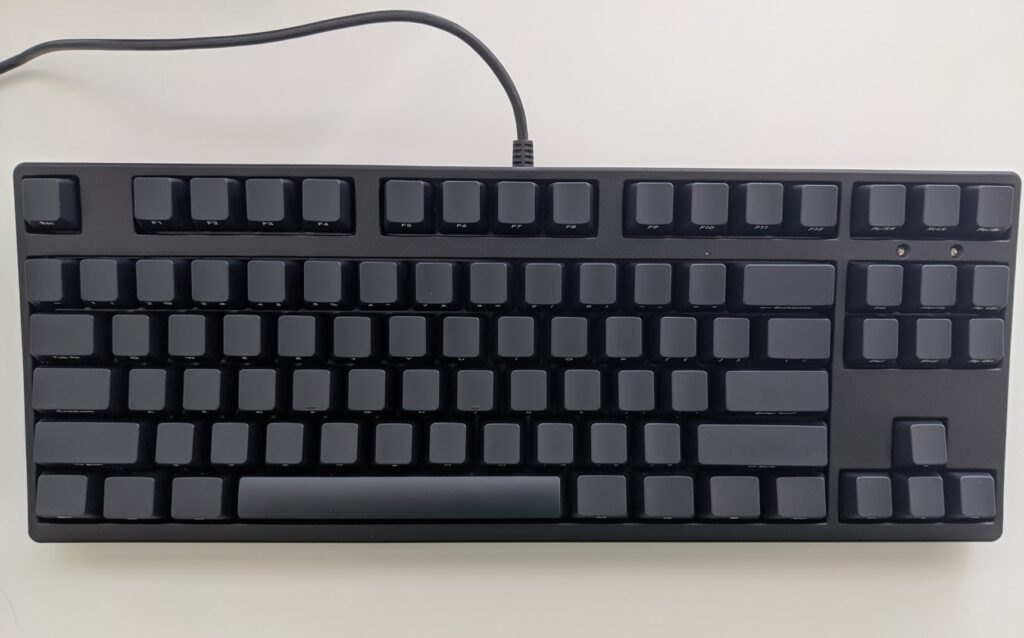
Keyboard: Filco Majestouch 2 Ninja Cherry MX Blue Switch 87 Key Mechanical Keyboard Black This is compact super-loud faceless mechanical keyboard. I love this keyboard and find it to be beautiful. It might be too loud to use if you are sharing space with others, so keep this in mind.
Mouse: Logitech® MX Anywhere 2S Wireless Mouse A nice precise mouse, though I often don’t like how it behaves on Chomebook. Not sure if this is an issue with the mouse itself or ChromeOS (and yes I tried to play with the settings).
Logitech MX Master 3. This is a full size and precise mouse. I am glad I replaced the old small one with this one.
Docking station: Dell WD15 Monitor Dock 4K with 130W Adapter, USB-C While docking station is definitely something to have I do NOT recommend this particular one as it is not fully compatible with newer Macs. My monitor flickers when I connect it via this docking station. Here is DELL’s support page on this. I’m using this station for power, internet connection, web-camera, and any further peripherals I will need to add to my work laptop.
KVM: Sabrent 2-Port USB Type-C KVM Switch with 60 Watt Power Delivery After much of extensive search I gave up looking for a docking station that has TWO usb-c power delivery outputs and also works as a KVM. This seems to be non-existent device. So instead, I bought myself a dedicated KVM. It is simple and it works. Power delivery is not always detected on my Pixelbook, so I skip PD option and use another cable to power my personal laptop on the right.
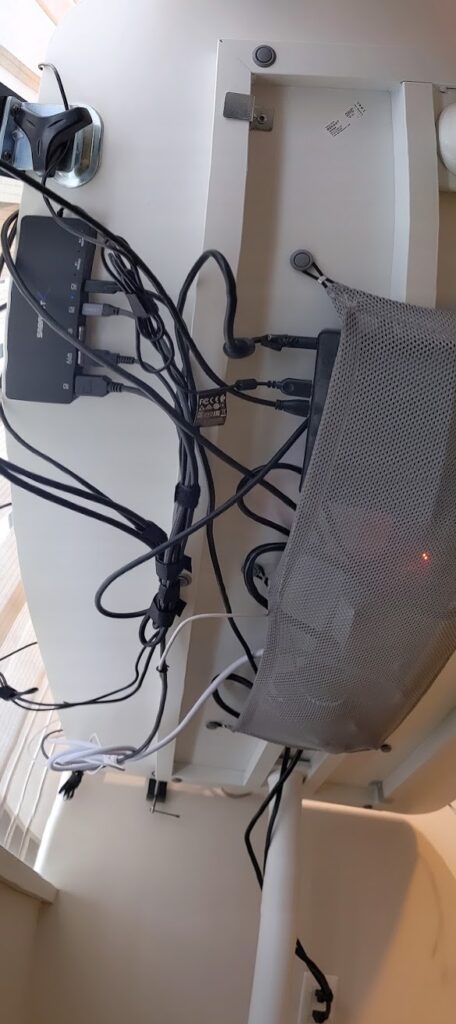
Power: BESTEK Power Strip with USB for charging devices, powering lamp, and occasional plug-in of things at top of my desk. I also use conventional power extender for low-power things under my desk and directly plug into the wall outlet more power demanding devices (monitor, docking station).
Desk Lamp: Swing Arm Lamp, LED Desk Lamp with Clamp, 9W Eye-Care Dimmable Light, Timer, Memory, 6 Color Modes, JolyJoy Modern Architect Table Lamp for Task Study Reading Working Home Dorm Office (Black) Super happy with this lamp – it can be bent in so many ways. I can recommend this one.
Vertical Laptop Stand: OMOTON Adjustable Something to hold my personal laptop vertically and save even more space. Anyway it is so much more pleasant to work on a large monitor (something I’m doing right now).
External Web Camera: Logitech C920S HD Pro Webcam with Privacy Shutter External webcam has its advantages of providing higher quality image with active focus. Unfortunately I probably need to add some swinging arm or a holder to it as right now I’m placing it exactly where laptop’s camera is and don’t think that my coworkers have even noticed a difference. I’m yet to test if mic is better on it in comparison to built-in one. Some people use dedicated external mics and their sound quality is noticeably better.
Backup power and internet connection: I also have two 20K+ mAh external power banks (one of which is enough to jump-start my car) and 20Gb of mobile internet plan. Based on my 4 hour testing this should take me through a full day of power outage. I know this is not ideal, but I’m also not running a data-center at home nor I have a detached house to buy myself generator or a similar solution. In fact, I do not remember unplanned power outage in my building since I live here and a planned one only lasted 4 hours.
Cables: Well… Everyone is ought to have some wire spaghetti under their desk. Right? I didn’t do anything special about the cables. Just tied some of them together so I don’t hit them with my feet.
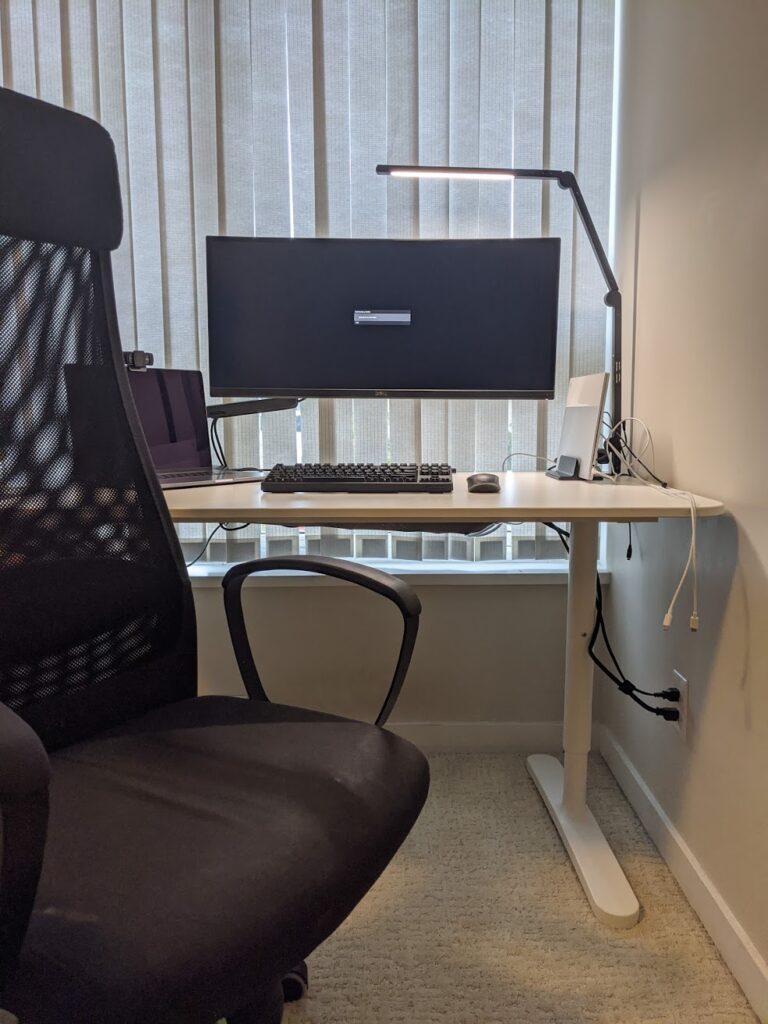
Desk and chair: Those are cheap IKEA ones. I’m considering to change the legs of my desk to make it height-adjustable standing desk. As of chair, I don’t think mine is great for 8+ hours of sitting in it.
As of 2021 replaced the chair with Autonomous ErgoChairPro.
Ok, back of my “office”
To complete the picture of my office here is what I have just behind myself:
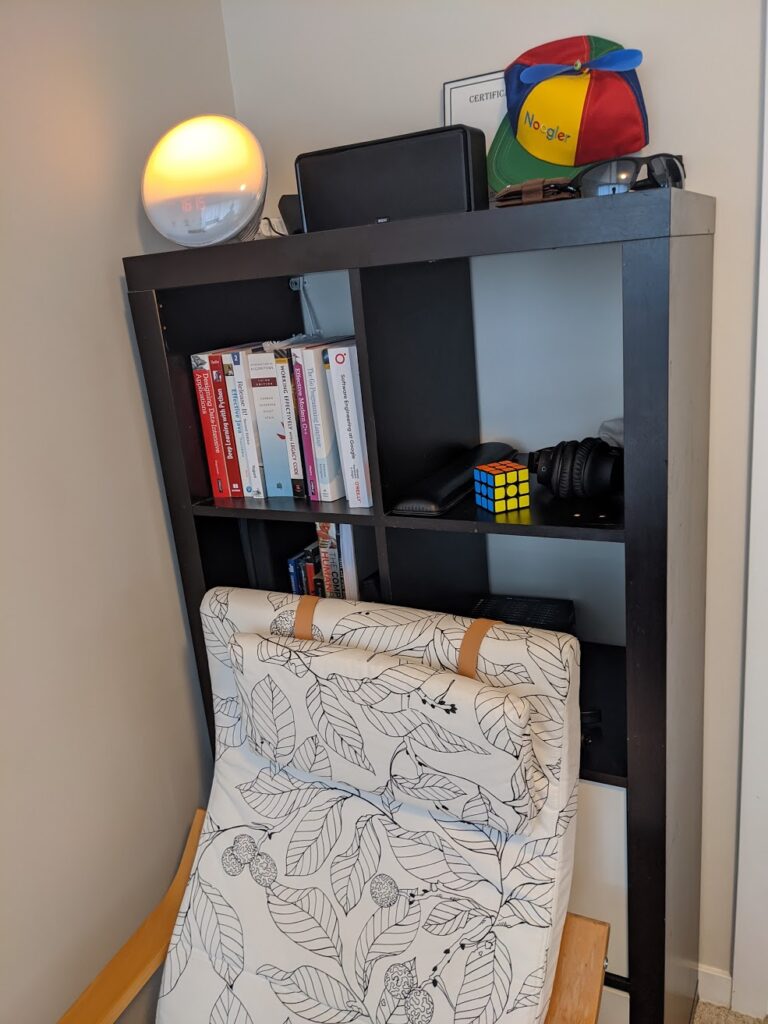
It is another IKEA chair for mental breaks and a bookshelf which has few books but mostly serves for accessing things I would use time-to-time, like keyboard palm-rest, other headphones, cables and few toys (no, I didn’t reassemble and then assemble the Rubik’s Cube – I can actually solve it). I’m also using the most expensive alarm I ever had which supposedly should help me wake up more naturally during winter months but doesn’t.
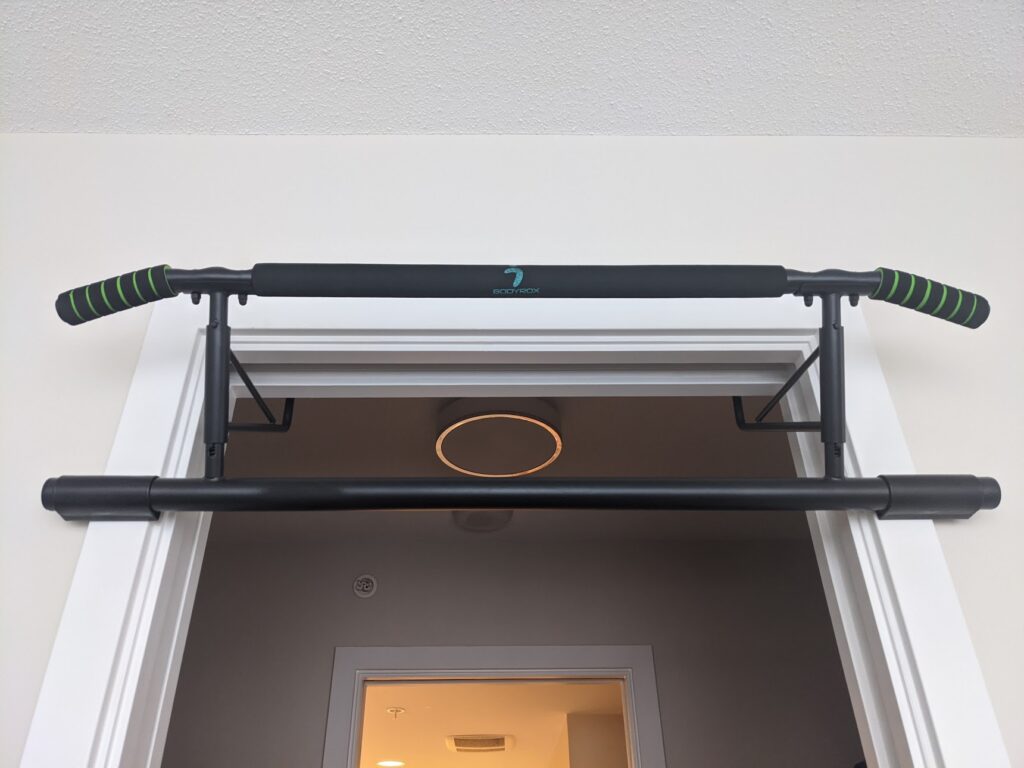
Last but not least, pull-up bar (BODYROX Premium Pull up/Chin up Bar) which I occasionally use during breaks. I consider it to be part of my home office as I wouldn’t buy it if I didn’t have to work from home.
No Personal things on Work Laptop
As mentioned above, I’m not logged in with my personal account on my work laptop – this means I cannot open personal gmail, facebook, instagram, twitter, favorite news site, whatever. When I actually need to do something personal I have to specifically log-in into my personal laptop, which means pressing KVM button. This small physical constraint and a clear separation not only helps to be fully compliant with whatever policies there are on the use of work laptop, but also helps to be totally focused on work. I find myself almost not switching to my personal laptop at all during working day (I take breaks, though). Additionally I blocked myself out of all of those distracting social media apps on my phone for working hours and limited their use to 15min/day/app with digital wellbing tools on my phone. I’m super happy about this (thank you, Google). In fact, this also helps me close item #23 on my new year’s resolution.
Your Feedback and Advice
I would be enormously happy to receive any advice from you on what I might be missing in my home office setup and what you would recommend. I understand our situations might be different but we are all in this together and if you have something to share please do so!
Running a Book Club
October 4, 2020 Opinion, RandomThoughts No comments
This is not a “how to” on running a book club. In fact I know next to nothing about book clubs and to run my first meet I googled what it takes to run such a thing. All of my previous stereotypes of book clubs were of bunch of super-boring people sitting in a circle and silently sipping tea (not coffee). After reading few articles I realized that I still know nothing about book clubs as apparently they could be run in myriad of different ways.
If you follow my blog you would notice that book reviews are one of very common blog posts here (55 of them), probably as common as technical blog posts and posts on success for software engineers. So no wonder I’m interested in reading and discussing books. One other aspect I’ve always been keen on is knowledge sharing. I used to share my knowledge via tech talks based on books and discussions called “design sessions”. It is not that I didn’t want to discuss books directly, but issue was that my audience in majority of cases didn’t read the book and still was interested in a given topic.
Last week I found myself in a situation when probably half of my team has already read or is reading one particular book. With a hint from my colleague, I kicked-off a book club. First meeting turned out to be a really great, fast paced discussion with a lots of engagement. I wasn’t the most active participant and this is awesome. Took notes and spoke only few times.
We went through highlights people remembered from the first chapter and then tried to analyze those, thought of practical applications, shared our related past experiences, and just had a good discussion. I would even call this to be some kind of a team building event – all virtual (in case you are reading this in future and COVID-19 is a thing of the past).
Once in 2012 I tried to organize “Code & Beer” and miserably failed with two people showing up. Arguably I just didn’t make it very clear I bought the beer for everyone :) This time people joined with no snacks but with tons of interest. So, how to run a book club? Who knows… Maybe make sure you have a “critical mass” of people interested in same book.
I Increased posting frequency
January 26, 2010 Opinion, RandomThoughts, Success No comments
I have 18th post this month that is more than in past three months. This means that I increased frequency of posting and I think that did not lost quality of its content. What do you think?
I think I’m good on this. I also increased amount of blogs I read (near 30).
Why do I think that blogging helps me?
- I’m learning how to express my thoughts.
- I grab only consistent knowledge on themas of my posts. This means that I do good research over internet before posting something.
- After I posted something I leave a good knowledge portion left in my mind.
- My blog will grow and I will get more readers so will be more famous. People needs this sometimes.
- This blog also could be a good visiting card for my further career.
To get more readers I need to have some certification that my blog is good to read and this could be reached only if I will continue learn something.
I also found one interested post where guy explains why Why Blog Post Frequency Does Not Matter Anymore. Yes, but my blog has defined content boundary and my posts are not something like posts on twitter, so I believe that it will lead me to Success.
BTW: If you are one of the guys who think that I’m too small fish to read my blog I would say: “Follow me and see if you will be so fast all the distance as I will be.”
Honestly I think we should see people in light of theirs attitude to something, but not in light of theirs knowledge of something.
Leave your comment with link to your blog. I will follow you immediately. ;)