Promotions in tech companies aren’t random, but they’re not entirely deterministic either. Here’s my humble attempt on a generic ‘mathematical’ formula I think makes sense.
Disclaimer: In no way this blog post represents the official position of the companies I worked for in the past or now. While I will try to make this generic, I’m definitely biased by my past experiences, plus my visibility is definitely not that of a VP level, so take this with as big of a grain of salt as you can imagine.
Background
In my career I had 5 promotions, 3 before FAANG and 2 at FAANG. I helped some of the engineers on my past teams get promoted, mentored a few people outside my org/team, and participated in the promo committee.
I’m definitely not in the high percentile in terms of how far I got with my promotions. There are people who are many levels higher, got there quicker, and didn’t write a word about it. Some think chasing titles is pointless or even toxic. Others say real engineers should just build what they believe in or launch their own startups. I’m writing because it is my thing. I had my path, and you and others have different paths, this is just how life works. So with that healthy dose of self-awareness and some humility, let’s develop a formula for success:
What is the ‘formula’ for promotion?
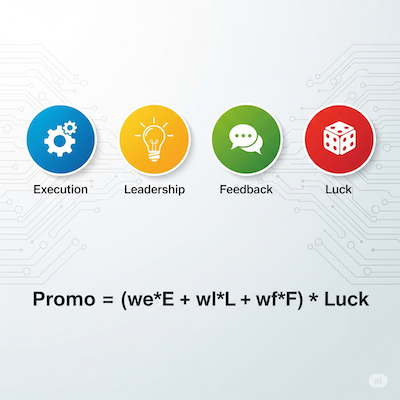
Unless you’re in a chaotic startup or very small company, promotions usually follow a structured process. The criteria often include your performance, leadership skills, and feedback from others. If I were to boil it down into a formula, it would look like this:

Where:
- Promotion: Readiness score where < 1.0 means not ready, > 1.0 means ready.
- Execution: Quantifies direct work (impact, quality, next-level scope); 1.0 = fully executing at next level, 0.8 = close.
- Leadership: Measures ownership, influence, and decision-making, partly quantifiable.
- Feedback: Continuous feedback and visibility through reviews, leadership exposure, and collaboration; hard to quantify but significant.
- Luck: Multiplier (0.5–1.5) that can amplify or dampen other factors; includes final promo packet outcome as a last-moment swing factor.
- Weights: Company and level-specific emphasis on factors (sum to 1); e.g., Meta/Amazon may set we≈0.5, a small company may set wf≈0.7.
Now, lets go over each of these with more details and my thoughts on how you can increase each one of them:
Execution
Most of the time this is the most significant part to promotion, especially at entry and mid levels. It’s the quantification of impact, quality of work, delivering results. Here are some very specific things you can do:
- Basics: Do your job and do it well.
- Quantification: Measure the impact of your work before, during, and after delivery. Even maintenance work can be framed in terms of what would happen if it weren’t done.
- Projects: Focus on high-impact, high-ROI projects. If your project doesn’t seem impactful, either (1) quantify ROI properly, (2) find ways to increase the scope/impact, or (3) if it’s truly low-value, align with stakeholders to drop it and move on.
- Quality: Show engineering or operational excellence, not just speed. This is because cutting corners may get quick wins, but over time they hurt your credibility.
- Scope: read the description of the next level and create mini-gap analysis if the scope of what you are working on is going to fill-in those gaps.
There are many other things to consider here, so see what you still need to do to tick all the marks of the next level of execution. That having said, strong execution gets you good hard data, but without leadership and visibility, it may not get you promoted.
Leadership
If you just joined the company as a fresh grad, not much leadership is expected of you, your Wl coefficient in the formula above will be really small (~0.1) and the higher you go the larger this coefficient is going to be. Companies have their approaches to how to measure this, for instance Amazon has 14 leadership principles, Meta has “Direction” and “People” axis, Google and other companies have their own things.
I will say something controversial, and hard to accept, but IMO a lot of your leadership potential is already backed in your personality at adulthood. I am not saying it is not possible to grow as a leader and improve, what I’m saying is that for some people it comes more naturally because they are more extroverted, confident, and more charismatic. To be clear: if you actively work on improving your leadership skills you will get much further than someone who has better prerequisites but isn’t trying to improve.
Usually, if you are going for promo, you would need to tick some boxes, depending on the framing you company is using.
- Influence. Have examples of influencing others. While influencing with authority is easy, for promotion you would need to show how you influenced peers or your leadership by presenting solid data, writing crisp documents, showing prototypes, telling convincing stories. If you have examples of where you influenced the roadmap at your skip level that would stand out. Trying to influence overly hard can backfire as people could perceive this as you being pushy, so come to them with clarity and data.
- Communication. Communicate clearly, timely, upwards. While this makes sense it is often a lot harder that it sounds. I’ve seen many solid technical engineers that really really struggle with communication. Sometimes the reason could just be English as a second language, but more often than not it is all the cluttering, odd structuring, that has nothing to do with the language proficiency.
- Strategic thinking: Strategize about your area of work, even if you are more junior show that you have given thought to how things should pan out in long term and if you are senior the expectation would be to create scope and solve ambiguous problems, or even find problems where others don’t even see them (yet).
- Trust: Build that trust because it takes time. Higher level leaders often operate on trust they have in their senior engineers.
- Dealing with ambiguity. The more straightforward the task is the less easier it is to automate and the more unvalued it is. At the age of AI, more and more of clearly defined tasks are going to be automated, so you bring value by being human and being able to deal with all of the missing pieces, unclarity and other things of that sort.
- Leadership gaps: Identify any company specific leadership requirements they might have, these can include: conflict resolutions, raising the bar, mentoring, etc.
At the end of the day someone will have to provide feedback about your work.
Feedback / Visibility
By feedback in my formula I didn’t just mean final feedback you get on your promo package but more of continuous things that includes manager/peer reviews, visibility with leadership, work with other people, this is hardly quantifiable in numbers but does play a significant role in the promotion as this builds that perception around you.
- Manager: Work with your manager to have a complete alignment on expectations and check-in regularly on your own initiative.
- Peers, cross-org, and your reportees: Just don’t be a jerk to others, express gratitude, be helpful. Doesn’t sound like much, but these things are appreciated.
- Higher leadership. Create a name for the project association in the minds of your leadership. When promo time comes you are not a simple spreadsheet line to them.
- Deliver visible wins: demo your work, share launch emails, and post in relevant channels so more people see the impact.
- Credit: Credit the team in public updates, but make your own role clear in 1:1s with decision-makers. Never take someone’s credit but be clear if you did contribute so that your credit is not misassigned.
Now, you might have all the great execution, leadership and visibility, there is one last piece that might override it all and it is the effect of luck.
Luck
One purely deterministic and cold-blooded view is that you are worth exactly what you are worth, meaning that if you somehow think you deserve a higher level this is simply wrong as you were not able to determine what it takes to get that what you want and therefore you don’t deserve it. Big companies have a data-driven approach to promotions, so if you have the data for the next level you would undeniably get it.
I do not buy this idealistic view and that’s why I introduced the Luck multiplier to my formula. It is a multiplier rather than an additive term, because it can significantly boost or dampen the effect of your other factors – you can execute and lead perfectly but still be blocked by bad timing, or get promoted earlier due to being in a high-visibility project at the right moment and because your org has big promo budget that time. You might have worked on a project that suddenly started making millions/billions of dollars growing and riding everyone’s careers with it or you might have worked on a failed project and got laid off.
So if there is so much you cannot control, do you just give up? Well, maybe, work on slightly improving your chances:
- Preparation. Deliberately invest learning and self-growth. While it might not give you that immediate promo, it can position you well in the future.
- Openness to opportunities. Do not ignore opportunities when you see them, evaluate them and act on them. It has some risk, yes, but as one of my first mentors once said “Never moving fish is a dead fish”.
Weights
Weights used in my formula are reflecting your company’s emphasis on each factor for a given level (they sum to 1 for normalization), for example companies like Meta or Amazon can make huge emphasis on Execution, making that We close to 0.5, while your small company really trusts what the others say about you so Wf is 0.7. At a very senior level your Wl becomes a much larger contributor.
Once you know your scores and weights, here’s how to move them.
Strategy and Tactical Plan
Here is the advice I give people when they ask me about promotion and it consists of two big steps:
- Career Strategy: Write down a strategy for your career. A long term one. One that describes what the hell you want to achieve in your career in 1, 2, 5 years. You don’t have to share it with anyone, but it will help you build clarity for yourself. Go, do it right now, create a Google doc, write some raw disconnected sentences, and expand to make it more crisp over time. I happen to be at Meta because it was part of my Career Strategy.
- Tactical Plan: Find a promo document template and start filling it in, even if your promotion is 1 year away.
- Start with a target date for your promotion, work out what makes sense, align that with your manager. If you are not getting definite ‘yes’ from the manager it is the feedback you are too aggressive and you might not see something.
- Identify any missing gaps, what’s needed to get you from A to B, start on your own based on your company’s framework and template, involve your manager, and gather feedback.
- Identify any blind spots, as usually there will be things you don’t know about, your manager might not be directly telling you. A mentor can help you get that outsider perspective.
Conclusion
Luck is outside your control, but readiness isn’t. Don’t judge others purely by their title, success of their project or generally where they are in their life, everyone fights their own demons and battles, you just don’t know. The best shot you have at a promotion is to consistently operate at the next level in execution, leadership, and visibility. In this post I’ve shared my formula:
Promo = (Execution + Leadership + Feedback) * Luck
If you work deliberately on each part, you shift the odds in your favor. Hopefully, what I’ve shared here gives you a clearer map for getting to your next level.
2 comments

| Markdown | Result |
|---|---|
| *text* | text |
| **text** | text |
| ***text*** | text |
| `code` | code |
| ~~~ more code ~~~~ |
more code |
| [Link](https://www.example.com) | Link |
| * Listitem |
|
| > Quote | Quote |

Всі про везіння зазвичай забувають)
Так – забувають. Я це зробив множником, бо воно може все перетерти, але частина на яку воно множиться також має бути не 0.