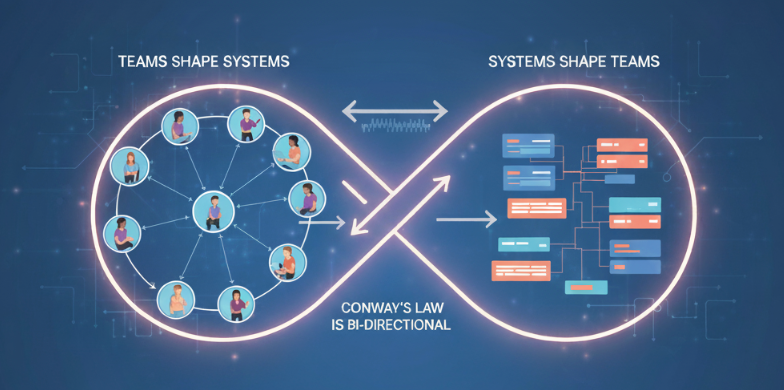
I once worked on a product where two Tech Leads couldn’t agree on direction. The result? Two different UIs for the same set of users. That’s Conway’s Law in action: systems mirrored organizational misalignment.
My personal observations over 17 years in large enterprise companies align with Conway’s. But I also believe this goes deeper. Causality runs both ways: organizations shape systems, and systems reshape organizations. In addition to this I think the technical problems the system is experiencing are reflections of communication dynamics.
Conway’s Law and Examples
A quick reminder of Conway’s Law: “Any organization that designs a system will produce a design whose structure is a copy of the organization’s communication structure.”. There are other variations of this. A simpler one I like to personally use in my conversations could be “Organizations design and build systems that mirror their own communication structure”.
For instance, if the company has extremely autonomous teams/orgs the company may end up in a situation where different systems are built with different tech stack and are fully decoupled but also hard to integrate if needed, but, let’s say if within an individual team/org communication is frequent and multi-directional their system might be tightly coupled and un-modular.
Direction of Causality: Org <=> System
So is it that once you have your organization you will end up with a particular system or is it while you build the system the organizational structure will simply organically mimic it?
That’s an important question and I’m of the opinion that this works both ways, meaning you can do re-orgs which will eventually lead to changes in technical aspects of the system, or you can make and push for design choices that over time will lead to org changes (like creating a team for a sub-module).
Companies sometimes deliberately reorganize teams or how they communicate (“Inverse Conway Maneuver”) to influence product architecture. This is one of the other reasons why re-orgs happen, but probably less frequently.
Take Amazon’s mandate for all of the internal teams to use AWS? I was on one of such teams and had to migrate some of our services to use AWS. This approach allowed Amazon to mimic external communication internally (external companies using AWS => internal teams using AWS). Internal engineers were both users and builders, so AWS could iterate quickly on real pain points. In this way feedback loop was that new communication channel that influenced how the systems evolved.
While Conway’s Law is usually stated as “organizations shape systems,” in practice I’ve seen a feedback loop. As soon as you draw a boundary in code, questions of ownership arise, and soon an organizational boundary emerges. Conversely, when leadership merges teams, systems often collapse back into monoliths or shared modules. Architecture creates new communication needs, which shape team structure, and team structure in turn reinforces or redefines architecture. This is why I argue causality is bi-directional: the system and the organization co-evolve.
When Communication Breaks Down
Communication bottlenecks eventually show up in code. Where teams don’t talk, APIs and integration points often become pain points. One team might be making assumptions about how the system behaves, they built their system based on that assumption and eventually operational issues show up. I personally observed this more frequently in micro-service based architectures, but monolithic systems are also susceptible to this.
Sometimes it takes introducing a liaison or two between two teams/orgs to fix things up. I have been working for one division at IAEA (UN) but was given to work on the project for another division, we were able to successfully integrate systems owned by two divisions. It is not so much just my contribution but rather a good decision to introduce new communication channels which resulted in changes to system integration.
Highly cross-functional teams often produce more rounded, cohesive, end-to-end systems. I’ve been on teams where many different roles were involved and worked very closely together (Meta seems to be very strong at this) as well as on teams where product management, database engineers were working in disconnected mode, producing outputs in sequence, which resulted in delays and systems that didn’t really do what they were supposed to.
Conclusion
Over and over I’ve observed mirroring between systems and communications structures, and I believe the causality is bi-directional, as such you can influence the system not just directly via design but by making organizational changes. The practical lesson is that you don’t always fix a broken system in the codebase alone. Sometimes the fastest path is changing how people talk, or who talks at all.

codemore code
~~~~