Previously I compared AI to an asteroid, with the simple premise that if your job is boilerplate CRUD, your job is a dinosaur, and if your job involves high leverage of AI, including building AI-integrated systems, your job is the mammal that survives.
AI Hype is real, it is everywhere, and honestly is somewhat annoying. My LinkedIn feed is oversaturated with all of the AI noise, I keep overhearing “AI” when walking past random people on the street. Everyone has their say on AI, including me. AI washing is a real marketing tactic used by many companies. Many people would get into AI just purely because of FOMO. And, honestly, that fear is justified, because what if you are really missing something and will be left behind. No one wants to be left behind. As a simple example, it is even hard to get a Mac mini because everyone is buying them to run their personal OpenClaw. I’m playing this game as well. I did set up OpenClaw on Docker just to see what I could do, but until I have a sustained workflow, I won’t be buying a dedicated machine. It’s easy to confuse playing with new tools for actual productivity. But, maybe, I’m missing out.
There is no smoke if there is no fire. Last week Anthropic released a labor market impact study claiming that hiring has slowed in highly AI-exposed roles since ChatGPT launch. For us, software engineers, the study claims that AI can theoretically automate about 90% of our jobs and it appears current automation is only at about 30%. If this is true and if this is happening soon, some kind of a combination of the two will happen: 1) our jobs will transform by a lot so that we are building ever new and more complex things that AI cannot and/or 2) there will be significant reductions in software engineering jobs. I don’t know if 1 or 2 would be a larger component of transformation but we should be preparing for both!
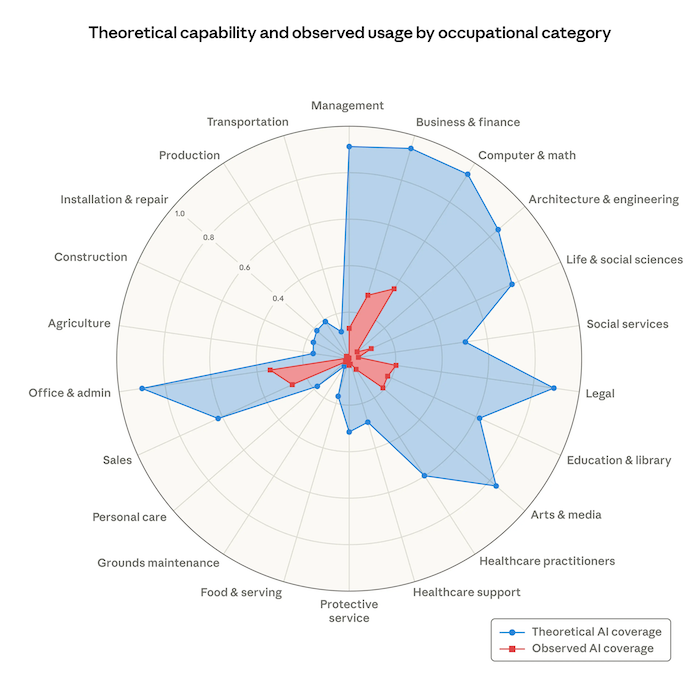
Image credit: Anthropic https://www.anthropic.com/research/labor-market-impacts
As I use Claude Code, it becomes apparent how it becomes more and more capable over time. It is no longer a question of whether the threat is real. It is absolutely real. The asteroid is here! It has hit the ground already. The transformation is already happening and if you don’t see it, you might be in trouble (that is unless you are a plumber or someone with a low exposure job). I still see value in myself by figuring out what problems to solve and then directing the work to my AI agents, sometimes finding myself directing 4 of them at once, which is really cool to be able to make progress on 4 things at once, but it is also terrifying. Does it mean I’m now 4x productive? Does it mean we need ¼ of engineers to do the same job? Or we will simply see another instance of the Jevons Paradox. Historically, making software development cheaper/faster didn’t mean we hired fewer engineers. What we have seen is that demand for more software has increased thus increasing the number of software engineers. But still, there are so many open questions that come with this transformation: like
- where do we get senior engineers if there is no need for juniors?
- would we ever reach “lights out” codebases not requiring human code reviews?
- would we hit the energy limits when it is more cost effective to pay a biological human rather than energy consuming AI? … and so many questions.
- what’s your question?
What goes up will go down. Things happen in cycles. What is born will die. I made the mistake of buying real estate in Vancouver at the peak of the market in early 2022, my property price has not yet recovered. Do you remember the COVID tech hiring frenzy followed by layoffs? Our industry over-hired only to lay off people after that. Do you remember the 2008 financial crisis and what happened to real estate prices only to recover some years after that? I am not old enough to remember the dot com bubble but it is all the same all across. My argument here is that we will see some kind of cycle of overreaction with AI as well. Some companies will over-invest in AI and not get anything out of it. Some companies will lay off too many people only to hire back. What we are looking at are micro movements, but what is more interesting is what will this bring us long term, what is the macro movement here?
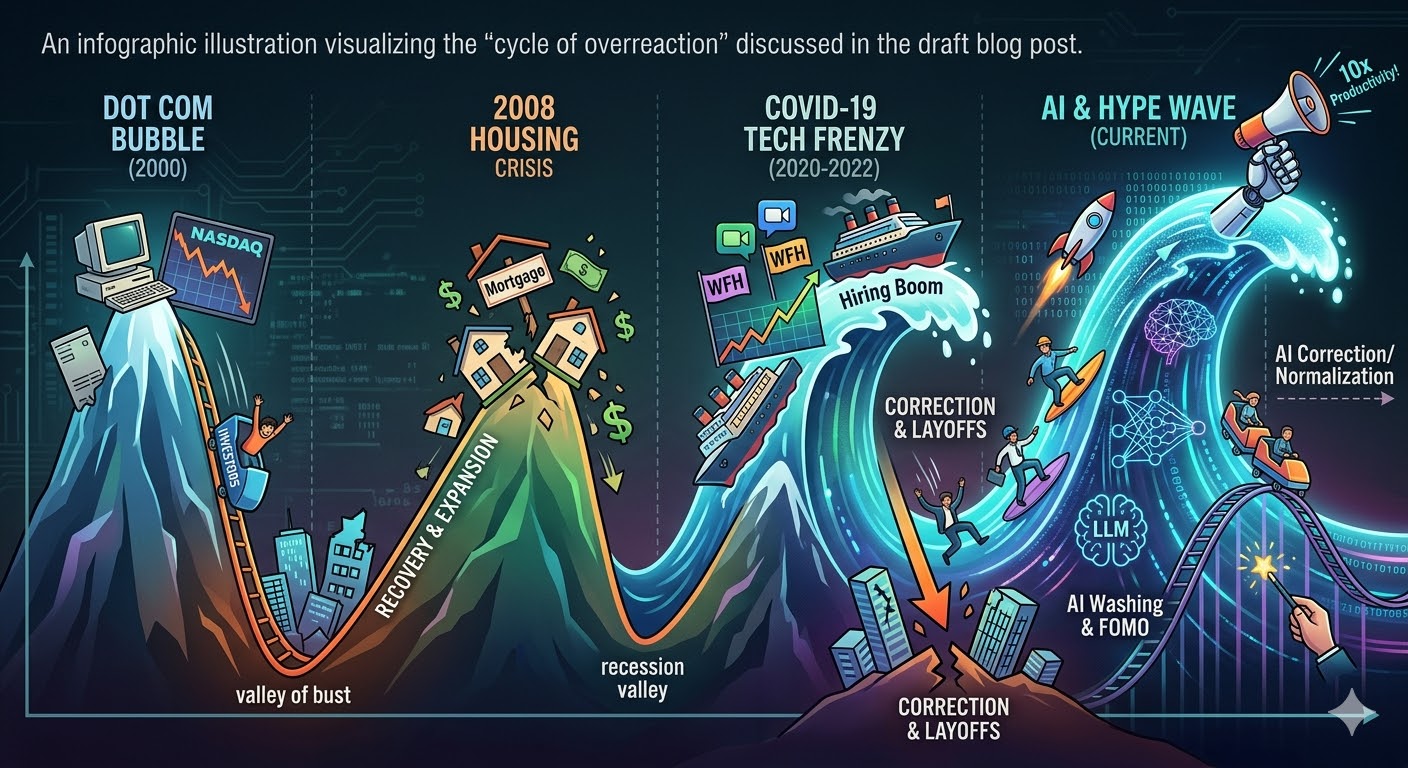
Image credit: Gemini on my prompt. The image is too colorful for my taste but it is kind of fun.
Dear reader, prepare for multiple outcomes. They say to have peace, you must prepare for war. Build a strong financial safety net, constantly stay on the lookout for what is changing, and adapt relentlessly. Every technological shift creates massive, unseen upsides. The rules of the game are changing and instead of panicking, the goal is to understand the new rules so you can keep playing.

codemore code
~~~~