January 25, 2026 Personal, Productivity No comments
The Internal Protest: Parenting Your Own Procrastination
My 9 year old son has been giving me a bit of a challenge lately, like protesting all the time, not wanting to go out, not listening to anything, saying “no” to everything, well you get it, all kids do this at some point and then again at some other point. So tiresome, but, well, this post is not about parenting.
While he has an adult to protest against, I realized that his external protesting is identical to the internal protesting I feel fairly often, and each one of us feels at times. We just don’t feel like doing something. It is likely a very similar mechanism to what kids experience except we are adults to ourselves. One part of our brain knows we “have to” do something, while the other part resists, looking for a shortcut or a break, like telling yourself that you will do it tomorrow. You know, tomorrow that mysterious place where 99% of human productivity is preserved.
In adults, this resistance usually looks like procrastination. Sometimes it is just watching Netflix or doing literally nothing. This form of procrastination is bad if it is supplemented with feelings of guilt. But often procrastination masks itself as productivity. One of my past coworkers once told me he “procrastinates by doing work.” He would avoid the one terrifying, high-impact task by doing ten smaller, easier tasks.
I do this too. If I have to work on a complex design document that requires untangling a messy legacy system, I might find myself refactoring some code instead or tidying the issue tracker. It feels like work, but it’s actually a form of avoidance. There is a term for this. It’s called structured procrastination.
I’ve often wondered if people who push through the pain actually get further (“no pain – no gain”) or if this is a recipe for burnout and failure. Do the structured procrastinators find their own path to success?
In the past I found some personalized ways of dealing with my own procrastination, such as: self-imposed deadlines, external visibility and accountability. Structuring things and setting very clear goals works best for me. While these mechanisms work fairly well, they have a ceiling pushing beyond which leads to frustration and burnout. So I was thinking what is that key solution that would truly keep you going in a sustained manner and bring internal satisfaction.
By looking at some of the psychological research on this, it appears a few things are key to this:
- Self-determination theory suggests that human motivation relies heavily on a sense of autonomy. My son does not like it when I tell him to go out for a run or a walk because he has no choice, but he sometimes joins me in the garage to kick the punching bag or “lift weights”. You might not enjoy that your project is basically given to you by your boss without your own input.
- Lowering activation energy. When dealing with large tasks oftentimes the hardest is just overcoming the initial 2 minutes of starting the work and that’s it. The protest is usually about the start, not going. Once my son starts doing something he usually gets through it. When I start some unthankful task at work I usually bring it to the end.
- Not feeling guilty. Procrastination is a stress-relief mechanism in a way. If you feel guilty about procrastinating you feel stressed, which makes you want to procrastinate even more. Beating yourself is counterproductive, instead just resetting next time without guilt is so much better. In one of my posts I wrote “starting something and then failing is OK as long as you start the cycle again and again, pushing the time of a failure further and further away in any given cycle” as such connecting periods of higher motivation together creating an upward trend.
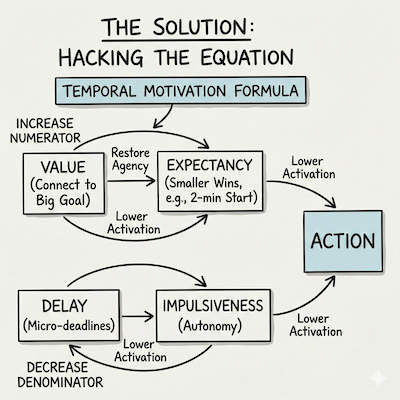
- Temporal motivation theory explains why “tomorrow” is a graveyard for human productivity. Here is the formula:

- Where:
- Expectancy: How likely am I to succeed?
- Value: How big is the reward?
- Impulsiveness: How easily distracted am I?
- Delay: How far away is the deadline?
If we don’t see value in something or if we think our chances of succeeding are not high our motivation drops. Likely, my son doesn’t see much value in going out for a run with me and his expectancy of enjoying or succeeding is very low. Similarly, if the deadline is approaching sooner our motivation increases. Having the formula above in mind is helpful, so instead of pushing with “willpower” you can do few tricks:
- Decrease the denominator by shortening the delay via micro-deadlines (like completing sub-task by end of day).
- Increase the numerator either by clearly connecting the value of your work to a big goal (like this weightlifting today will make me more attractive) or increasing chances of success (I cannot run 10k, let me run 5k so I can do it).
Conclusion
When my son protests he isn’t trying to be difficult. He is just experiencing a low in his motivation equation, maybe the task feels imposed, too difficult, or low value. As an adult, I have to parent myself with the same empathy. Instead of beating myself up for “being lazy”, which only increases stress and procrastination, I need to move the levers that I know work and have worked for me in the past:
- Restore autonomy. Remind myself I choose to do this.
- Lower activation energy. Just start for 2 minutes.
- Not feeling guilty. Instead, restart with new energy and do better next time.
- Hack the formula. Create micro-deadlines and easier wins.
Either way, we need to find proper ways to self-parent ourselves. Good luck.
.