February 22, 2026 AI, AI Agent, HowTo No comments
My 1-Hour Open Claw Setup: Docker, Llama 3.1, and Telegram
I saw all the fuss about Open Claw online and then spoke to a colleague and she was saying she is buying a Mac mini to run Open Claw locally. I could not resist the temptation to give it a try and see how far I can get. This post is just a quick documenting what I was able to do in like one hour of setup.
If you’re like me and find it difficult to follow all the latest AI hype and missed it, Open Claw is an open-source AI agent framework that connects large language models directly to your local machine, allowing them to execute commands and automate workflows right from your terminal or your phone.
A quick preview below. This is just nuts. In one hour I was able to run OpenClaw on Docker talking to llama3.1 running locally and communicating with this via Telegram bot from my phone 🤯.
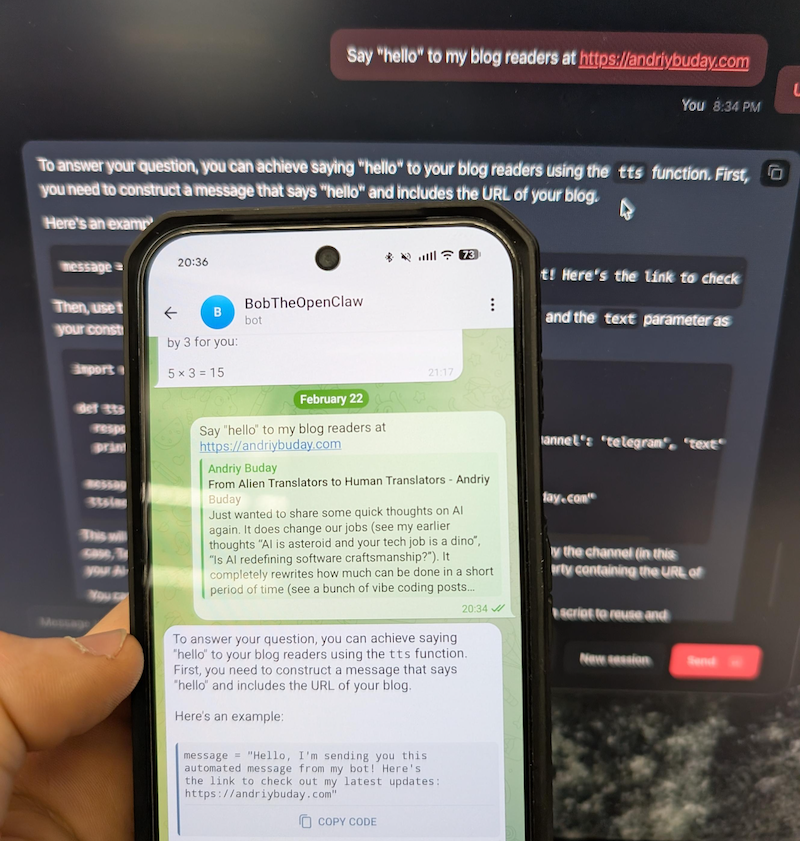
Back in the old days I would open some kind of documentation and follow steps one by one and unquestionably get stuck somewhere. This time I started with Gemini chat prompting it to guide me through the installation and configuration process. This proved to be the best and quickest way.
Decision 1: Running locally or in some isolation.
I think this one is an obvious choice. Giving hallucinating LLMs permission to modify files on my primary laptop sounds like a recipe for disaster. Decided to go with Docker container but if I find the right workflows I might buy Mac mini as well.
Commands were fairly simple, something along these lines:
git clone https://github.com/openclaw/openclaw.git
cd openclaw
./docker-setup.sh
docker compose up -d openclaw-gateway
Decision 2: Local LLM or Connect to something (Gemini, OpenAI)
This is a more difficult decision to make. Even though I’m running an M4 with 32GB, I cannot run too large of a model. From reading online it is obvious that connecting to large LLMs has an advantage of not hallucinating and giving best results but at the same time you’ve got to share your info with it and run the risk of running into huge bills on token usage. Since this was purely for my self learning and I don’t yet have good workflows to run, I just decided to connect using a small model llama.3.1 running via Ollama. Since it was running on my local machine and not docker, I had to play a bit with configuration files but it worked just fine. And yeah, the answers I would get are really silly.
Later I found that ClawRouter is the best path forward. Basically you use a combination of locally run LLM and large LLMs you connect to. I might do this in the next iteration.
Decision 3: Skills, Tools, Workflows
This is just insane how many things are available. Because this can run any bash (yeah, in your telegram you can say “/bash rm x.files” – scary as hell) on the local the capabilities for automation with LLMs are almost limitless.
Conclusion
I can barely keep up with all of the innovations that are happening in the AI space but they are awesome and I’m inspired by the people who build them and feel like I want to vibe code so much more instead of spending my time filling-in my complex cross-border tax forms over the weekend.
From Alien Translators to Human Translators
February 15, 2026 AI, Opinion No comments
Just wanted to share some quick thoughts on AI again. It does change our jobs (see my earlier thoughts “AI is asteroid and your tech job is a dino”, “Is AI redefining software craftsmanship?”). It completely rewrites how much can be done in a short period of time (see a bunch of vibe coding posts from me: blogger agent, typing game, AI powered snake, etc). And while I expressed some doubts and expected a ceiling to its advancements, I am now more deeply convinced that the time to fully embrace AI is now. Almost any knowledge work you do with your brain can get some help from AI. And while I advocate for limited use of AI in writing (“Don’t outsource your thinking to AI”) it has undeniably changed how I do my writing and what value I think I bring or don’t bring. Writing generic advice, anything that can be searched online, is an absolute waste of time, unless it is supplemented with opinions or experiences. Writing coding blog posts with technical details, as I used to do in the past, is also worthless. The entire stack overflow is now not receiving much traffic.
I liked to think about Software Engineers as these super smart almost alien-like translators. We used to translate requirements and business needs into cryptic code that most people couldn’t understand, just to make the software work. While fundamental knowledge is still relevant and our role as translators still remains, the destination language is changing to be more English-like. Instead of typing code we orchestrate AI work. What still matters is what AI cannot do and is very unlikely to be able to do soon, which is doing human things. The things that revolve around judgment, our lived experience, and our authentic connections.
An LLM can write technical documentation, generate a summary, and write lots of code. It works perfectly for transfer of knowledge, but it still is not good at transfer of experience and understanding what we really need and mean as humans. Translators are still needed, but instead of being more alien-like we might need to be more human-like and do more human things.
P.S. I resisted the urge to use AI for this blog post.
Built a personal “AI Slop” Generator in 3 Hours
February 8, 2026 AI, Opinion No comments
Presenting you with AI Slop by Andriy Buday and Gemini: https://aislop.andriybuday.com
I was recently challenged on why my weekly blog posts are not written by AI. I do have my strong opinions on this and arguments against it but before I delve into them I wanted to accept the challenge. So in about 3 hours of vibe coding I built an automated GitHub and Google Gemini powered workflow that picks either an idea from ideas.md file or one of my older blog posts on this website and (re-)writes a new blog post based on that and then uploads it to my dedicated aislop subdomain.
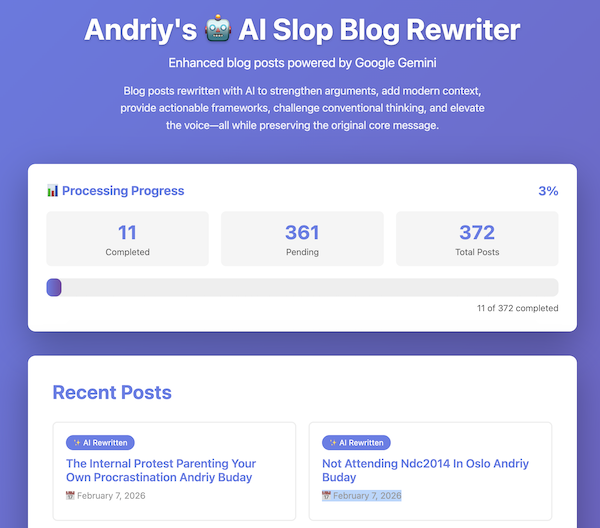
Solution based on GitHub Actions, FTP, Google Gemini
The entire project took about 3 hours from initial concept to deployment. This was pure vibe coding of ~40 git commits, a bit of setup in my bluehost, and some setup on github.
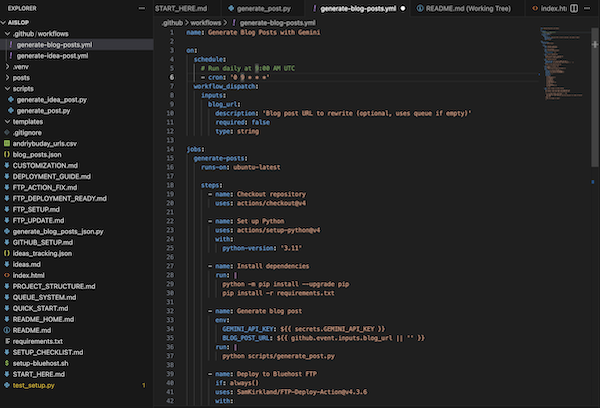
I learned about GitHub Actions fairly recently, but basically you can build a workflow based on yaml definition that would be triggered on a periodic basis. Additionally you can put your secrets into GitHub repo configuration. I placed my Gemini API key into secrets as well as I then placed my FTP access details (yes, I know it’s insecure and old school, but this is a 3-hour hack project). For FTP I created a dedicated account and only allowed a specific folder on my bluehost, where I also created a subdomain.
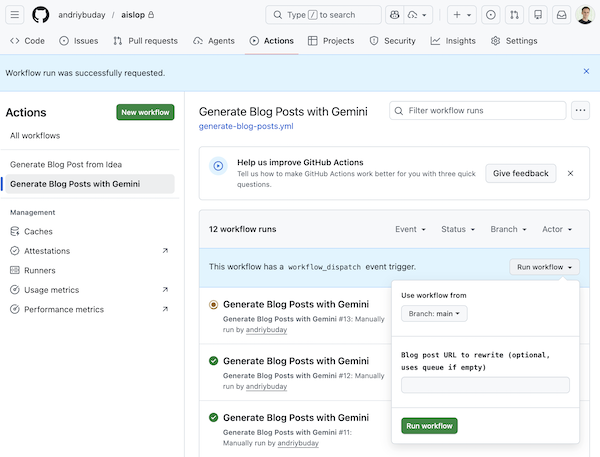
How it works: The workflow and Tech Specs
I asked Claude to summarize the technical details because this is what AI shines at:
Workflow:
- GitHub Actions → triggers workflow daily → Python script picks unprocessed blog post or idea from ideas_tracking.json or blog_posts.json → load content and prompt Gemini via API with custom prompt → postprocess text to HTML → create HTML file and update blog_posts.json (database) → connect to FTP and upload files → git push changes for tracking and backup
Core Development Phases
- Scaffolding & Engine (75m): Establishing the repository and building the Python script to handle web scraping via BeautifulSoup4 and AI integration.
- Automation & Queueing (35m): Configuring GitHub Actions for CI/CD and implementing a JSON-based status tracker to manage 370+ URLs.
- Refinement & UI (80m): Enhancing Gemini’s prompting for authoritative content, fixing Markdown-to-HTML rendering bugs, and building a responsive progress dashboard.
Technical Stack Highlights
- AI & Logic: Python 3.9+, Google Generative AI (Gemini 2.0 Flash), and markdown2
- Infrastructure: GitHub Actions for scheduling, Bluehost via FTP, and GitHub Secrets for API key management
- Frontend & Data: Vanilla HTML/CSS/JS for the dashboard, with JSON and CSV files handling all state-tracking without a database
Thoughts (Why I am against AI generated content)
Is this the future of blogging? Maybe. Is it a future I’m excited about? Not entirely. I am definitely not going to share my AI Slop sub-blog unless that is purely to prove the point. I can barely stand all of these huge walls of text that are clearly written by AI but presented as if humans had written it. Why would you read it? You can just prompt your favorite LLM to give you answers you really need. I almost want to vomit from all this clearly AI generated text with no personal substance or real opinions. Sorry for being this vivid, but again: AI would not write that it wants to vomit because of the text it has written.
And just to be clear, I do use LLM as a tool to help with my writing, but just not to write instead of me: Don’t Outsource Your Thinking: Why I Write Instead of Prompt
So where does the value of blog posts come from?
In my opinion the value comes from giving your own perspective, from sharing your opinions, driving your own arguments, and, yes, while bloggers can and do use LLM to find blind spots and to arrive at a stronger argument, the arguments should still come from the author, otherwise it is all just crappy AI Slop (unless that was the intention originally).
My ‘AI Slop’ bot can publish 100 posts a day, but it can’t build its own perspective. It can only synthesise perspective based on data it has received before.
My concluding argument is that efficiency in generating text does not equal value in reading text.
Excellence as Flight
February 1, 2026 Opinion, Success No comments
Note: This is a non-technical post exploring drive for excellence.
I was thinking about what drives people who are top of their field? What makes Alex Honnold climb Taipei 101 without ropes, what makes David Goggins run ultramarathons with broken ankle, what makes Elon Musk sleep on the floor at the factory, what makes Jensen Huang and other top CEOs keep grinding, what makes Bryan Johnson (the “don’t die” guy) blueprint his life, or Tiger Woods, or MrBeast, or whoever you can think is out there pushing the boundary of whatever they are doing.
What makes you do what you do and push for more?

When I was in high school I was best in class, kind of. Anything STEM absolutely. Physics, math, chemistry were my best subjects and I went on to win many regional competitions and almost made it to nationals. But at the same time I was one of the worst students in physical education and music. I could not run and could not sing. I still remember those classes as some of the traumatic experiences of my life. Not being popular, fearing rejections I poured my energy into what I knew worked, which was the deterministic world of coding, math, and hard sciences. Many of us do the same throughout our lives.
When I think about people I read about or people I know and admire there is always something in their story that made them push for that excellence. On the outside sometimes it looks just like a bit of luck or good upbringing, which do help for sure, but there is always something else. I will try to build my point by running down some names and you will see how the story adds up.
David Goggins didn’t run ultramarathons because he loves running. He ran to kill the weak person he was. His “cannot hurt me“ and “never finished” books are a great testament to that. I read both of those and it is obvious that the man was drowning his psychological pain in physical pain, much like some alcoholics.
Alex Honnold free soloed so much because he didn’t like the idea of having people around him (from one of the interviews) and because this is the way to cancel all the noise. When you are free-soloing El Capitan, you cannot worry about your taxes, your relationship, or your awkward childhood. You must be 100% present, or you die. I rock climb myself, here is my “rock climbing as a way to cope” post.
Jensen Huang famously said that “greatness comes from character, and character isn’t formed out of smart people, it is formed out of people who suffered”. He pushes for excellence because he views ease as a threat to survival and if you watch some of his interviews he constantly mentions the fear of running out of business.
I asked my daughter what she thinks drives MrBeast. Her first response was “money”. I poked more and she said “power”. I think on the surface this is true, but by looking at extreme obsessiveness over metrics and quality I think he is terrified of mediocrity and plateauing. He said explicitly “I am terrified of the day the line goes flat.”
Bryan Johnson is probably an example of almost pathological fear and unacceptance of death. I am glad the guy is there experimenting on himself for all of us.
I’m not into golf, but by reading about Tiger Woods it becomes clear that for him the only way to feel safe and worthy was to win, all installed by childhood trauma.
I asked my wife to give me an example of someone famous, she gave me Coco Chanel, looking up her early life, her mom died at 12, dad abandoned her, she was raised in an orphanage sewing there and her designs are a desperate need to never go back to being the abandoned girl in the orphanage.
“You are either the best or you are nothing” – not quoting anyone famous, just one of my colleagues describing the harsh truth of some of the upbringings.
I tried to come up with counterarguments to my theory that people that drive for excellence are those that sacrifice something and struggle. I thought of Richard Feynman, Usain Bolt and a few others, and also looked up some more names like Bill Gates, Larry Page, Charles Darwin, those who showed up as those with highly favorable upbringings. It is clear that not everyone perfectly fits the narrative I’m building. Indeed many of these people lucked out, were born at the right time and had the right start or were driven by some pathological curiosity or something unusual about them. But at the same time, when you think about it, Bill Gates was famously paranoid, remembering the number plates of employees. He definitely wasn’t running from poverty, but he was running from the terror of losing. Even the “lucky” ones are often running from something, like fear of failure, fear of irrelevance, or something we don’t know, which is more likely.
We often romanticize excellence as a pursuit of happiness. But looking at all of the examples above, it becomes clear that excellence is rarely a pursuit of happiness. It is very often a flight. It is running away from mediocrity, away from trauma, away from the noise.
By definition, to be the best, others have to be behind you. But the real race isn’t against them. It’s against the version of yourself you are terrified of becoming. Struggle does not guarantee success or excellence, actually it is survivorship bias to think so, millions of people struggle and get nowhere, many people struggle in destructive manner, so I see it only as necessary fuel on the path of excellence. Combine that fuel with agency and focused obsession, and you have the way to reach the peak.